


Thank you!
Your response has been recorded.
Our team will be in contact with you shortly.
Meanwhile…
Catch some of our stories while you wait!
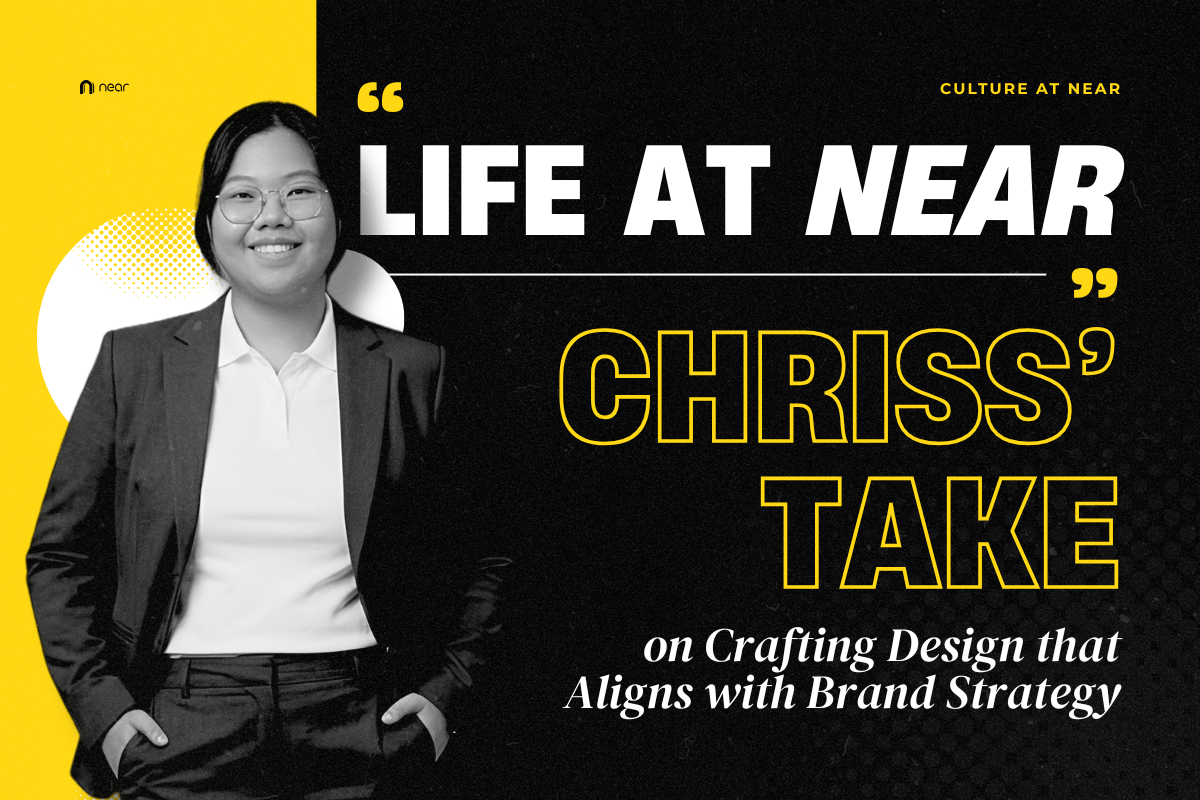
Life at Near: Chriss' Take on Crafting Design that Aligns with Brand Strategy
Take the next step with us: nearcreative.co/careers
Creative designers bring out the vibrance and color in a creative agency. Without our artists, strategies and executions will look more like abstract thoughts. Their visual interpretations breathe life into the ideas of the team.
Simultaneously handling multiple accounts alongside creative executions for the Near brand, Chriss, Near’s junior creative designer, is a significant contributor in making the brand what it is today: an agency that wins campaigns and a trusted partner of our clients.
This is their Life at Near.
CREATIVE PROCESS OF A PERFECTIONIST-PROCRASTINATOR
Chriss firmly believes that “When the momentum hits, I just ride it until the work is done.” A self-described perfectionist-procrastinator, they tend to put tasks on hold and deprioritize those that don’t require immediate attention. But when that spark of inspiration finally hits, they work with full intention and give it their all, like a true creative.
But every creative knows that accomplishing deliverables daily can’t always rely on suddenly reaching the right headspace. So they condition themself through small routines, like a boost of caffeine, sitting somewhere quiet, or being in the company of their cat rescues, Powder and Truffle. These help them settle and go into focus mode, making them feel present before accomplishing tasks. Once they feel present, motivation and clarity eventually follows. Lastly, one thing they swear by? Never create on an empty stomach. If your body feels neglected, your mind will likely not function properly either.
Chriss’ Principle:
To create from honesty and be intentional with your work, having small conditions that ground you, keep you awake, and emotionally open are all needed.
Chriss’ creative core is rooted in the human experience and tapping into their vulnerability, especially with their personal projects. Outside of Near, they are an artist that expresses themself through songwriting and illustration. Their creative process exists in a spectrum, some born from serendipitous realization and some deliberately created after self-reflection.
For Chriss, inspiration either comforts you or disturbs you, but both are important to artistic expression. They immerse themselves into other people’s art, stories, and conversations because they believe that creativity becomes limiting when your only sources are your own experiences. And despite not having everything figured out yet, they find beauty in how we feel things viscerally and how it breathes life into our creative works.
Chriss on art:
Art comes from exposure, empathy, and feeling, no matter how uncomfortable or uninteresting.
COMBATING CREATIVE BURNOUT
Given the fast pace of the industry, Chriss too, has experienced the inevitable burnout. Just when they thought they had everything figured out, they began noticing lapses in their work: treating tasks as checklists to be ticked off and failing to mentally engage themself in the process.
They saw this as a turning point that could lead to stagnance if ignored. Especially in a saturated landscape, where variations of design blend with others, outputs can appear technically correct, yet end up lacking depth, perspective, and humanity.
So they confronted their artistic approach, shifting passive execution to more intentional, strategic thinking; starting with asking the right questions and challenging ideas, which strengthened their relationship with other departments. Chriss also began setting boundaries with others and themself. They learned to be more conscious of their limitations and practiced asking others for help, realizing that sometimes the best outcomes come from involving the right people.
Working at Near also enabled Chriss to experience simple things that made them connect beyond deliverables such as Real Human Days, team lunches, and company dinners. They appreciated how it broke the humdrum of office hours and reminded everyone that they’re parts of something more.
DESIGNING WITH INTENT, GROWING WITH THE BRAND
Chriss witnessed first-hand how the structure evolved in Near. Big changes always push for growth, so they perceive this as an effort to maximize ways of working. Starting as a graphic designer that purely executes, they eventually became more involved in conceptualization and project direction; a change they found creatively fulfilling.
When bringing ideas to life, their main thought is to design with intent, connected to a reason backing up the execution and ownable to a specific brand. Chriss claims that identifying the big ideas is the hardest part of the artistic process. The why that connects all branches before materializing the how is what sets us apart from any machine generated insight:
“This is a human problem that requires lived experience.”
Chriss learned one very important thing, that is moving with empathy. Before as employees, they began seeing everyone as humans first, including themself. This helped them ingrain a mindset to treat feedback as a way to strengthen every execution. Filtering criticisms made them grow more as a team player who’s now more open to perspectives and collaboration.
Broadening their perspective on growth also made them choose it every time, even if it means leaving your comfort zone. They say to remember two things: honesty and courage, regardless of the uncertainties. Chriss’current position at Near’s creatives team, they describes it as:
“A rollercoaster ride where you’re seated at the very end—where everything feels more intense, unpredictable, and fast-paced.”
Sometimes Chriss describes the work as a rollercoaster ride despite managing to ride it only once in their lifetime. Because for them, “a step nearer” doesn’t mean ignoring your worries to move forward, but to choose to do it scared. Working at Near made their experience a rollercoaster of challenge and excitement: frightening and unpredictable, but helping them become more certain and open to new possibilities.
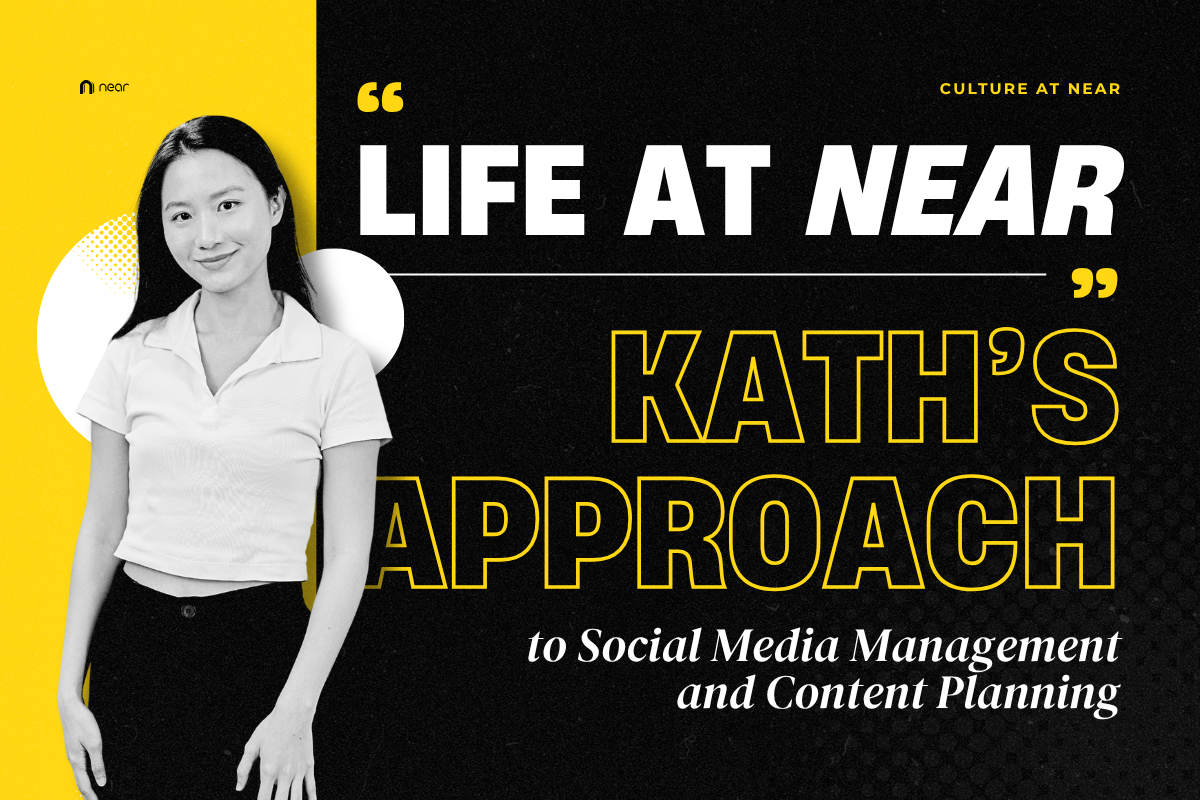
Life at Near: Kath’s Approach to Social Media Management and Content Planning
Not every social media manager starts with a perfectly curated feed or years of platform experience. Sometimes, it starts with curiosity, openness, and the willingness to say yes to something unfamiliar.
For Kath Tsang, that “yes” changed everything.
As a Junior Social Media Manager at Near Creative, Kath now works on social media strategy and content planning for multiple brands—helping turn ideas into content that resonates, engages, and performs. But just a year ago, she didn’t even have a TikTok account.
This is her Life at Near.
Building Content Through Collaboration
Kath’s journey into social media wasn’t linear. She initially joined Near as a freelancer, supporting the team through copywriting and influencer management. Over time, her work ethic and adaptability stood out and when the opportunity came to step into a full-time social media manager role, she took it. Despite having no formal background in social media management, Near took a chance on her. And she took a chance on herself.
Today, she manages content across brands, contributing to social media strategy, content ideation, and day-to-day execution: a shift that reflects how growth at a creative agency doesn’t always follow a fixed path.
For Kath, one of the most exciting parts of her role is the creative process behind content planning. Brainstorming sessions are where ideas come alive. What starts as a simple suggestion evolves through collaboration, each team member builds on one another’s thoughts until it becomes something stronger, sharper, and more aligned with the brand.
It’s in these moments that social media stops being routine and becomes creative problem-solving. Because in a fast-moving digital space, creating content is about constantly finding new ways to tell a story that feels fresh, relevant, and meaningful.
Balancing Work, Life, and Consistency
Unlike traditional roles, social media management requires a high level of responsiveness, flexibility, and attention to detail. Kath’s experience working remotely—even while traveling—became both a challenge and a defining part of her growth.
Being able to work from different places allowed her to show up for important personal moments without stepping away from her responsibilities. And in doing so, she realized something important: taking care of her personal life made her better at her work.
That balance translates directly into how she shows up for brands—more present, more thoughtful, and more consistent in execution.
One principle guides Kath’s work in social media strategy:
Care for the brand.
Even if she isn’t the target audience, she believes it’s important to understand the value a brand brings, and genuinely wants to see it succeed. That mindset allows her to take initiative, think ahead, and contribute beyond just assigned tasks. Because effective social media management is about ownership, intention, and belief in what you’re building.
Growth Through Openness
Kath’s growth at Near has been shaped by both opportunity and mindset. Professionally, she was able to transition into a field she had long been interested in but initially lacked experience in. Starting as a freelancer and gradually earning trust through her work allowed her to step into a full-time role—proof that growth doesn’t always come from credentials, but from consistency and willingness to learn.
Personally, Near became a steady anchor during a time of change. It gave her structure, independence, and a sense of purpose while still allowing her to explore what she truly wants in her career. One of the biggest skills she’s developed along the way is grit: learning to ride the waves of work as they come, especially in an industry driven by trends, algorithms, and constant change.
What makes the experience more meaningful for Kath is the culture at Near. There’s a strong respect for personal time: team members avoid messaging each other while on leave, and work-life balance is treated as a shared responsibility. At the same time, office days, team lunches, and dinners create space for connection beyond work. It’s a balance that allows people to perform well without burning out. Kath admits her career path wasn’t exactly planned—but that’s exactly her advice. Be open.
Some of the best opportunities might not look like what you originally imagined. Saying yes to something unexpected might lead you closer to where you’re meant to be.
If she had to describe her work life at Near, Kath sums it up best: In a situationship with the algorithm.
But beyond that, her journey reflects something deeper. Near brought her a step closer to the life she once dreamed about as a kid: one built on flexibility, creativity, and the freedom to grow into who she wants to become.
Looking to build a career in social media strategy, content planning, or digital marketing? Explore our job openings: https://nearcreative.co/careers
How to Turn Founders into Your Strongest Creators on LinkedIn
Founder content is becoming one of the smartest growth levers in B2B marketing. On LinkedIn, where buyers already go to learn, evaluate, and compare, founders have a unique advantage: they can make a brand feel credible, human, and worth listening to long before a sales call ever happens.
The case is getting harder to ignore. Thought leadership now carries more weight with B2B buyers than traditional marketing materials, and creator-led content is outperforming old-school brand posts on the signals marketers actually care about: trust, engagement, and consideration. LinkedIn influencers are already part of that shift. The next step is realizing that your own founder might be one of the most powerful creators your brand has. Research from LinkedIn and Edelman found that 73% of B2B buyers see thought leadership as a more trustworthy way to assess a company’s capabilities than traditional marketing materials, and 86% say strong thought leadership makes them more likely to invite a company into an RFP process.
So how do you turn founders into strong LinkedIn creators without making their content feel stiff, overproduced, or self-important?
1. Stop treating founder content like company-page content
The fastest way to flatten a founder’s voice is to make them sound like a corporate banner ad in human form.
Founder-led LinkedIn content works because it feels personal, opinionated, and close to the work. It carries the authority of someone actually building the company, but it lands because it still sounds like a person. That’s the gap many B2B brands miss: buyers want expertise, but they also want humanity.
This is exactly why founder-led content matters on LinkedIn. LinkedIn’s own B2B creator research frames the future of thought leadership as people-powered, not page-powered. Buyers don’t just want polished messaging—they want perspective. And when that perspective comes from a founder, it can reduce perceived risk before a sales conversation even starts.
That also means founders should not just post company updates. They should talk about the problems they’re seeing in the market, the decisions they’re making, what they’re learning, and where their point of view differs from the category. That’s what creates gravity.